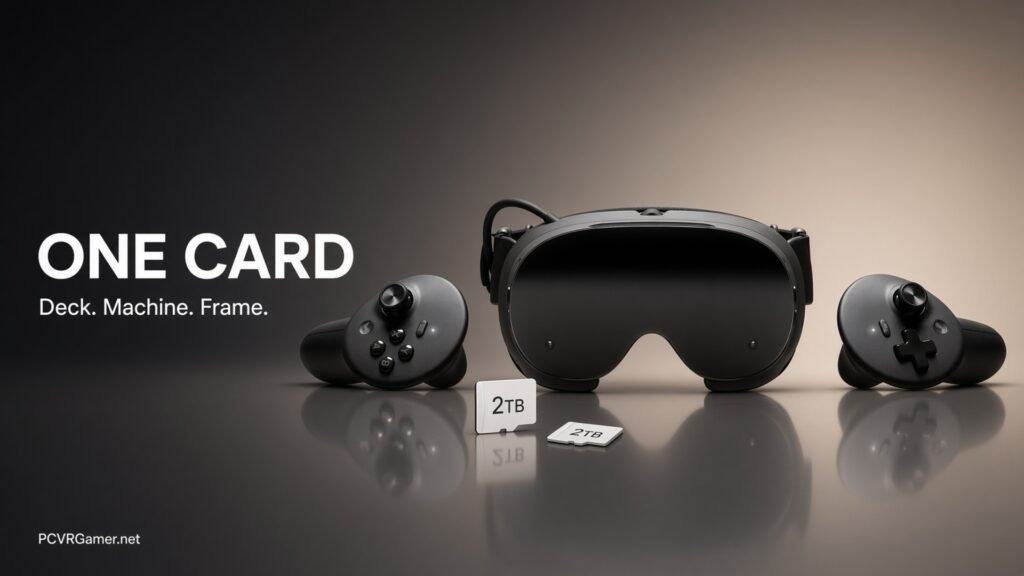
Valve built a microSD slot into the Steam Frame, and that is not a footnote. It is how the headset plugs into the rest of SteamOS.
The store page lists it right next to the internal drive: 256 GB or 1 TB of UFS, plus a microSD card slot for extra storage. The slot sits in the front of the strap with the facial interface and speakers. Pull a card out of a Steam Deck, drop it in the Frame, and the installs come with it.
That is the feature Meta never put on Quest 3 or Quest 3S. Those headsets ship with fixed internal storage — 128 GB or 512 GB — and no microSD slot. If the drive fills up, you delete games. You do not add a card.
Same card, three machines
Steam Frame, Steam Deck, and Steam Machine all run SteamOS and all take microSD. Valve’s line is that the cards are fully interoperable. Steam Frame engineer Jeremy Selan put it like this: you can take your catalog from a Deck or a Machine, plug it into the Frame, and bring it along. Format the card for SteamOS once, install games to it, and the library shows up on whichever SteamOS box you slot it into. You are not re-downloading 80 GB because you walked into the other room.
That is why the card starts to feel like a cartridge for the whole Steam hardware pile — handheld, living-room box, and headset — instead of a Deck-only spare drive.
Two extra terabytes
Valve’s spec for the family is SDXC up to 2 TB, same ceiling as the Deck. Internal storage stays what you paid for. The card is additive. A 256 GB Frame plus a 2 TB card is 256 GB of fast onboard UFS and two extra terabytes you can yank out and move. A 1 TB Frame plus the same card is three terabytes of install space if you fill both.
Steam Machine engineer Yazan Aldehayyat told PC Gamer the company thinks you get a good experience off SD cards, with load and boot times still in a good place. That is Valve talking about the ecosystem slot, not a reviewer guessing.
Games on the internal drive, movies on the card
Steam Frame is a PC. Valve’s own product page says you can install your own apps, open a browser, and treat it like any other SteamOS machine. The microSD volume is just another drive. Park bulky movie and TV files on the card and keep the internal UFS for standalone game installs. That is the practical split: games that need to launch stay on the faster onboard storage if you want them to, media that only needs to sit there lives on the card.
Valve has also said SteamOS has a built-in browser and that streaming services should work in a theatrical browser mode on the Frame. Local files on the card and streamed shows in the headset are two different paths. Both exist because this thing is SteamOS, not a locked phone OS with a sealed drive.
What card to buy
Match the Deck. Official Deck spec is UHS-I, with support for SD, SDHC, and SDXC. The cards people already use in a Deck are the cards Valve said will move across the family. Stick to name-brand microSDXC, A2 / U3 / V30 if you can, and skip no-name 2 TB listings that cost twenty bucks. Those are how you lose a library.
Street prices move week to week. Recent public listings for cards that already show up in Steam Deck buying guides:
- 512 GB name-brand UHS-I (Samsung Pro Plus / Amazon Basics class): about $50
- 1 TB Lexar Play / Lexar Blue: about $105
- 1 TB SanDisk Extreme: commonly the “whole library” pick in Deck guides
- 2 TB Lexar Play: listed around £172 in UK Deck roundups
- 2 TB SanDisk Extreme: recent U.S. listings around $270–$280 for the standard Extreme; Extreme Pro 2 TB listings run much higher, into the $480s
Those are listing prices from 2026 buying guides and store pages, not a promise they will still be there tomorrow. NAND pricing has been ugly all year. Check the live tag before you click buy.
You do not need a microSD Express card. That is a Switch 2 thing. The SteamOS slot is the older UHS-I interface. Paying extra for Express speed does not help a Deck, and Valve never advertised Express on the Frame.
Why this matters on a $1,059 headset
The 256 GB kit is $1,059. The 1 TB kit is $1,299. A 1 TB or 2 TB card is cheaper than that $240 jump, and unlike the internal upgrade it travels. One card can feed a Deck on the couch, a Machine under the TV, and a Frame on your face. Quest cannot do that trick because Quest has nowhere to put the card.
If you already own a Deck and a fat microSD, the Frame’s storage story starts before the reservation email lands. The card you formatted last year is the accessory.