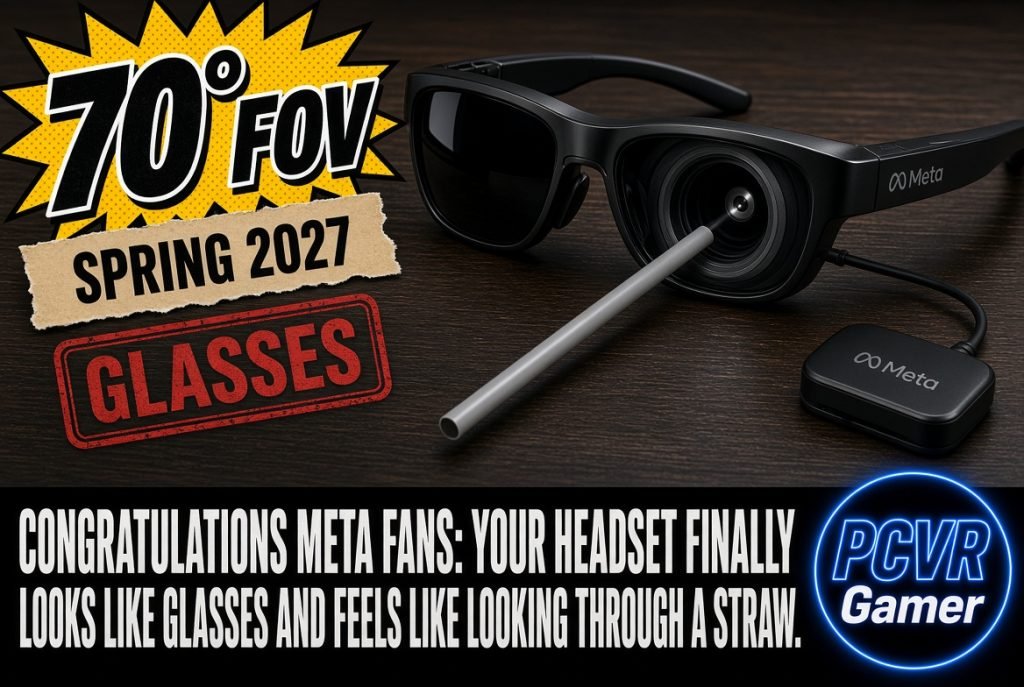
Meta’s new VR Glasses, announced at Connect on September 23, 2026, are the most wearable VR device the company has ever shown. About 100 grams on the face. No strap. A pocket puck. 5K micro-OLED panels at 37 pixels per degree. IMAX Enhanced. $1,299.99, arriving spring 2027. meta.com
That list is impressive. It is also incomplete. The number that decides whether a headset feels like a world or like a screen is field of view. Meta advertises 70° horizontal × 66° vertical, about 87° diagonal. uploadvr.com That is not a small trim from Quest 3. It is a different class of visual coverage.
Hands-on reports already said the quiet part out loud: the glasses do not cover your entire field of vision, so they do not feel as immersive as a traditional headset.
wired.com That is not a nitpick. It is the core trade.
Why FOV is not a spec-sheet luxury
Human binocular vision is roughly 200° horizontal and well over 100° vertical, with a large central overlap that gives stereoscopic depth. VR does not have to match that exactly. It does have to stop reminding you that you are looking through a rectangle.
FOV does four things that resolution cannot:
- Presence. Peripheral vision is how the brain decides you are in a place instead of watching one. Cut the sides and the world collapses into a floating panel.
- Situational awareness. In racing, flight sims, social VR, and combat, you need to see a threat, a teammate, or a cockpit gauge without turning your whole head.
- Comfort. A narrow window forces more head motion. More head motion means more vestibular conflict. Wide FOV is not just “more wow.” It is less work.
- Scale. Objects at the edge of a 70° window feel closer and smaller than the same objects in a 110° window, because the virtual world is being cropped.
Pixels per degree make text sharp. FOV makes the room exist. Meta optimized the first and accepted a hard loss on the second.
How to read FOV numbers without getting marketed
Manufacturers mix three different figures:
- Horizontal / vertical FOV — the useful pair. This article uses those.
- Diagonal FOV — a single number that inflates well. Pimax’s old “200°” claim is a diagonal marketing figure, not 200° left-to-right.
- Rendered vs visible FOV — software can draw more than the facial interface lets you see. Face shape, eye relief, and IPD change the result by several degrees.
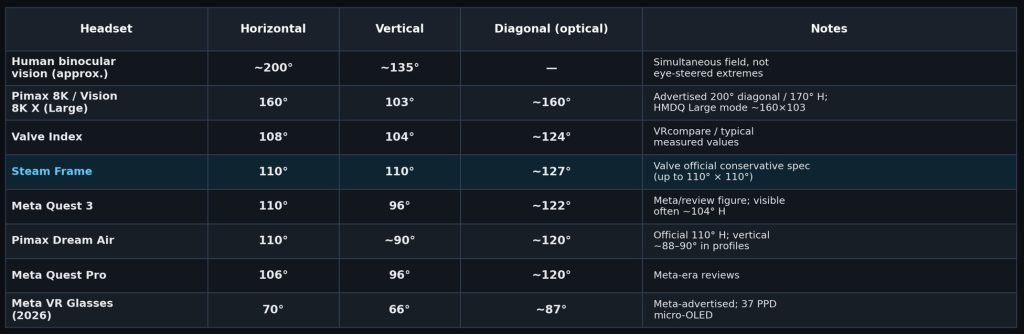
Pimax’s 8K-class headsets were advertised as 200° diagonal / up to 170° horizontal / 115° vertical. Independent geometry dumps for Vision 8K X in Large mode measure about 160° horizontal × 103° vertical. vr-compare.com That is still enormous. It is not 200° of side-to-side vision.
For a fair comparison, these are the figures used below:
Conclusion: who is this for?
Gamers will not choose this. Beat Saber, racing, shooters, flight sims, and social VR all punish a 70° window. You lose enemies, cockpit instruments, lanes, and body language that every current headset keeps in view. Strapping a $1,300 peep hole to your face and a puck to your pocket so you can play Quest games through a letterbox is not a future. It is a downgrade with better contrast.
Productivity users will not choose this either. Day-to-day work is not “look through binoculars at a virtual 32-inch panel, then take them off because the real world is still leaking in around the edges.” If the job is multiple screens, Quest 3 already does the large virtual canvas without making you crane your neck for the corners. If the job is walking around a workplace, these are still obvious, tethered, blacked-out goggles. They are not glasses you forget. They are a face-mounted monitor that refuses to fill a face.
Cinema is the only story that almost works, and Meta ruined even that by dragging IMAX into it. IMAX exists to occupy more of your eye. Certifying a 70×66 device as the first IMAX Enhanced VR product is an insult to the word. You can put a pretty HDR image in a toilet-roll tube. That does not make the tube a theater.
So the remaining customer is a keynote. A person who wants the idea of VR without the helmet, and is willing to pay headset money for AR-adjacent form with neither AR’s all-day wearability nor VR’s immersion. That is not a market. That is a demo unit. META VR glasses are for the people with 50 VR headsets on their shelf and none of them have been used more than an hour.
Meta had the last decade of FOV lessons in-house. Quest 2 felt tight. Quest 3 fixed enough of it that people stopped talking about binoculars. Index taught the industry that usable FOV is a design goal, not a leftover. Pimax spent years proving that if you actually want periphery, you have to build for it. Dream Air already occupies the “small visor, high PPD” lane without collapsing to 70°. Meta looked at all of that, shipped a sharper postage stamp, and called it presence.
The honest product name is personal cinema goggles. The honest answer to “who is it for?” is: not gamers, not workers, not anyone who already owns a Quest 3 and remembers what a world feels like. If you cannot name the user without recycling the press release, you do not have a product. You have a $1,300 argument that looking through a hole is the same as being there. It isn’t.